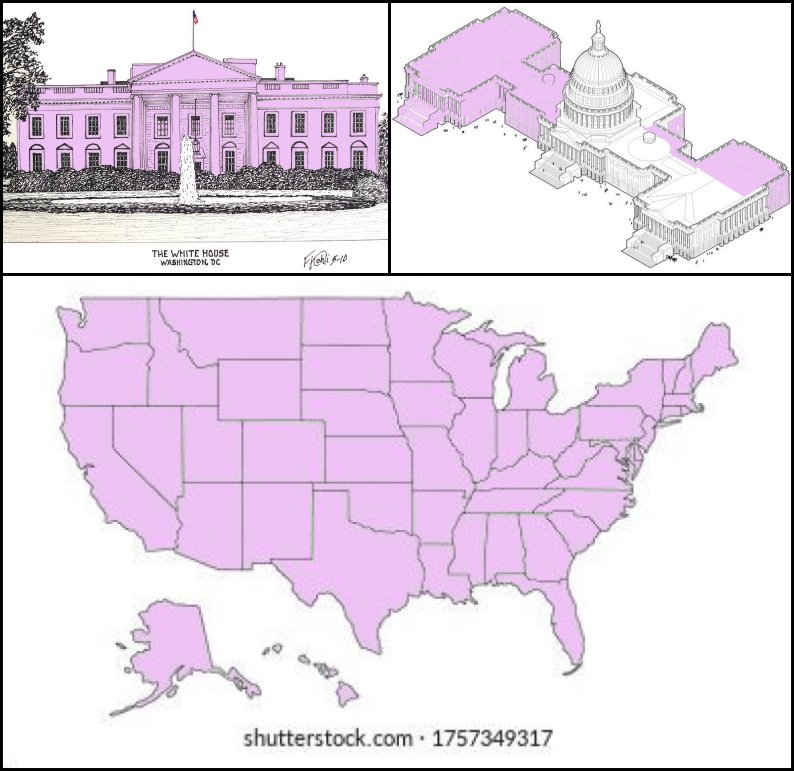
It’s that Time Again
2024 is a Presidential Election year.[1] The general election will be held on Tuesday, November 5, 2024.[2] It will be the 61st Presidential Election in our country’s history. This year, we vote for many other Federal, State, and Local offices as well. At the Federal level, in addition to the President and Vice President, all seats in the House of Representatives (2-year cycle) and about one-third of all Senate seats (1/3 each 2-year cycle) are up for election/re-election. The purple shading in the composite header image of this article is my effort to represent this pattern.
Promises, Promises
Candidates for political offices make promises. They don’t always keep those promises. Some of them are exaggerating. Some of them are lying (or delusional). Some of them are phrasing their intentions as though they are inevitable.
It’s not difficult to slip into exaggeration, especially if you’re highly invested in what you’re talking about. There have been times in my past when I’ve caught myself exaggerating. You may have done the same. Discredited and expelled former Congressman, George Santos, is an example of outright lying. A well-known example of intentions spoken as inevitable occurred in the 1988 Republican National Convention when the then-incumbent President George H.W. Bush said, “Read my lips: no new taxes” in the acceptance speech that began his campaign for re-election.
Contrary to the belief of some candidates and their supporters, the President of the United States is not omnipotent. The framers of the Constitution of the United States created a Federal government with three branches … Legislative, Executive, and Judicial. In theory, the branches balance each other and prevent any one branch from overpowering the other two. The Legislative branch (Congress) makes the laws, the Executive (Presidential Administration) branch enforces the laws, and the Judicial (the Courts[3]) branch interprets the laws. Addressing our biggest problems and concerns … like taxes, the border, infrastructure, and health care … usually requires the passage of new laws. That’s the job of Congress.[4] The President can propose and encourage (or discourage) the passage of laws, but the House of Representatives and the Senate do the heavy lifting. The President’s only Constitutionally-required part of the process is to sign or veto laws that Congress passes.
What about Executive Orders?
The President can issue executive orders without the need for legislation from Congress. Executive orders take effect as soon as the President signs them.[5] Executive orders can be quite useful, but they have some shortcomings:
- Executive orders only apply to functions, programs, property, and employees within the domain of the Executive Branch. Laws apply to the whole country.
- Congress can pass laws that override executive orders or make them difficult to implement.
- Executive orders issued by one administration can be eliminated by executive orders of any succeeding administration.
The Courts get the Last Word
Both laws and executive orders can be subject to Judicial Review. Sometimes a person or group will question the legality of a new law or executive order and file a lawsuit against it. The lawsuit may go through a series of appeals to successively higher levels of the Judicial system but, eventually, the Courts reach a final decision. If that decision opposes the law or executive order, the law or executive order will have to be revised to meet the requirements of the law or to be dropped altogether.
Adventures in Voting
If democracy is to work for everybody, everybody has to participate. If you are eligible to vote but don’t, you can’t complain about the results. (Well … you can, but you’ll have trouble justifying your complaints.) Primaries and caucuses began with the Iowa Republican Caucuses on January 15th. Many have cast their votes through early voting, mail-in voting, and absentee voting. Those who have yet to vote in primaries and caucuses … and all of us in the general elections in November … would do well to consider the following:[6]
- When both the House of Representatives and the Senate are controlled by like-minded individuals, the Federal Government is less likely to deadlock.
Like-minded individuals does not necessarily mean members of the same political party.[7] A bill needs 218 votes to pass in the House. Because of the Senate’s filibuster rule, a bill needs 60 votes to pass in that chamber of Congress. When the parties’ numbers are close to these limits and highly polarized as they are now, a few extremists in the ruling party can bring the Legislative branch of the Federal government to a screeching halt.
- For the foreseeable future, the Presidency is a binary choice.
The last third party candidate to be elected President was Abraham Lincoln. Lincoln was also the first Republican President.[8] Voting for a third party candidate is a waste. I made the mistake of voting for a third party candidate, H. Ross Perot, in 1992.
Richard Nixon had shown that he was, in fact, “a crook“. Gerald Ford’s pardoning of Nixon was disappointing. Jimmy Carter was plagued by inflation and a stagnant economy. Ronald Reagan helped end the Cold War, but was too conservative for my changing political leanings. George H.W. Bush was OK, but not inspiring. (I was a mere child of 47 in 1992.) Clinton was an unknown quantity … and, younger than I was. Ross Perot “talked a good fight”, split the conservative vote, … and received 0 votes in the Electoral College. Bill Clinton won. I had wasted my vote.
I might have been a very unhappy citizen for 8 years but, as it turned out, I grew to like President Clinton. I had learned that voting for a third party candidate is counter-productive.
- Federal, State, and Local governmental entities relate to different aspects of our lives and communities.
If you approve of a President’s proposed agenda, it is reasonable to elect Senators and Representatives that share that vision. Does that mean that you should vote for every candidate on the ballot who are members of the same party as the Presidential candidate you select? No, it does not. If it were that easy, we’d only need to list the name of the Presidential candidate or party. Everyone else would simply ” go along for the ride”.
The most obvious reason that we need to vote for all offices on the ballot is because many of the offices are not part of the Federal government. They are State Governors, Legislators, Secretaries of State, Attorney Generals, etc. They are Mayors, City Council People, District Attorneys, Police and Fire Commissioners, and any number of other local offices. Each level of government has its own particular needs and responsibilities. Sometimes, the levels may work together, but function semi-independently to serve the People.
- Single-issue voting can have unforeseen consequences.
Our governmental structure is a very flat pyramid. In 2022, State and Local governments employed an estimated 19.2 million people. In 2023, the Federal government employed an estimated 2.95 million people.[9] Each level of government depends upon and is effected by those above and/or below.
In a structure like this, a relatively few loud voices at one level can cause ripples that reverberate through the whole structure … especially in our diverse and never silent communications environment. The reverberation can make the concern/problem seem much more pervasive than it really is. The result … single-issue voting. The best example in our country’s history of single-issue voter movements yielding unforeseen and very unpleasant consequences is embodied in the 18th and 21st Amendments to the U.S. Constitution.
The temperance movement began in the 1830s. Its ardent followers came to believe that alcohol consumption was at the root of a wide variety of social ills. While slavery and the Civil War dominated the middle of the 19th century, the temperance movement festered under the surface. By the beginning of the 20th century, prohibition was among the most intense and loudest social movements. The 18th amendment was ratified on January 16, 1919. Prohibition became the law of the land.
It didn’t work out the way temperance leaders expected. They did not have the broad support they thought. The demand for drinking exceeded the fear of it. The money spent on alcoholic beverages did not automatically turn to what the prohibitionists believed to be “higher endeavors”. Alcohol consumption went underground. Restaurants failed because they could no longer offer alcoholic beverages as part of “a nice night out”. Other parts of the entertainment industry began to suffer. Many producers of alcoholic beverages lost their livelihoods. Those who could afford it, changed their business models. By producing everything from ice cream to truck bodies, some breweries survived.
Bootleggers, smugglers, and rum-runners replaced formerly-legal producers and distributors. Speakeasys replaced neighborhood bars. Organized crime grew by running much of the alcohol business. Graft seeped into government and law enforcement. Some former patrons turned to stronger drugs to replace their booze. Others died because they consumed illicit liquor tainted by toxins. In December 1933, ratification of the 21s amendment reversed the 18th and the failed experiment of alcohol prohibition came to an end.
- Compromise is not a dirty word.
In the 1860s, Otto von Bismarck said, “Politics is the art of the possible, the attainable—the art of the next best.” If we really want to deal with the nation’s problems and to help with the world’s, compromise means:
Making a deal between different parties where each party gives up part of their demands; finding agreement through communication and mutual acceptance of terms … often involving variations from an original goal or desires;
The term “without compromise” is fine in discussions of theory.[10] In the practical matters of running a country being without compromise is tyranny.
- Intentions are real.
When a candidate makes promises without providing context,[11] those promises can be nothing but empty words. If the words sound too good or too bad to be true, those words are suspect. If the candidate does provide a context, one needs to consider the question, “Does the candidate’s description of his/her approach make sense?” A candidate for a Federal office who says, “I’ll propose/sponsor a law to eliminate the Electoral College,” is either ignorant of the law or is counting on your ignorance.[12]
Learn to listen to what a candidate says; not just what others say about that candidate. As you learn to listen to the candidate thoughtfully, you will begin to sense his/her intentions. What is the candidate saying? How often does the candidate repeat the same message? Does that message make sense? Do you agree with the message and the way the candidate is expressing it? True intentions may not be spoken but, to the attentive voter, they show through any rhetorical fog.
There you have it. The race to November 5, 2024 is off and running. I’ve tried to keep partisan politics out of this article.[13] I’ll have plenty to say about that in future articles.
If you want to share this article … through social media, re-post, e-mail, or any other medium …, please feel free to do so.
If you have any comments or additional ideas, I encourage to leave a reply in the comments section at the end of this article. (The link below will skip over the Notes section.)
[ Go to Main Menu ]
Notes
[1]
2024 is also a Leap Year. Unless you are an immortal hiding your age from the census taker, the coincidence of Leap Years and Presidential Election Years seems to be a constant. It isn’t. The every 4-years cycle of Presidential Election Years is defined in Article II of the Constitution of the United States. Because the first of those election cycles began on Monday, December 15, 1788 (a Leap Year), they will coincide with Leap Years … most of the time. But, in the definition of the Gregorian Calendar, any year evenly divisible by 4 is a Leap Year unless it is also divisible by 100. Therefore, to be a Leap Year, “century years” must be evenly divisible by 400 in order to be a Leap Year. 2000 was a Leap Year; 1900 was not. If the country and the calendar survive, the next break in the Presidential Election/Leap Year coincidence will occur in 2100. Some who are alive today may experience a Presidential Election Year that is not a Leap Year.
[2]
In recent years … especially those during the COVID-19 pandemic … most, if not all, states have enacted early voting days, mail-in voting, and/or absentee voting. The first Tuesday in November is just the last day that voting may occur. Contrary to the opinions of some, vote counting continues until all legal votes have been included in the count.
[3]
Article III of the U.S. Constitution defines the Judicial branch to be “one supreme Court, and in such inferior Courts as the Congress may from time to time ordain and establish“.
[4]
If you were born in the 21st Century, you probably aren’t familiar with “Schoolhouse Rock!” If you were born in the 20th Century, you may not remember it. In 1996, one episode of this series of public service announcements explained how a bill becomes law.
[5]
During the first 9 days of his term in office, President Biden issued 34 executive orders and a number of other executive actions.
[6]
Some of the concerns listed are memories of something I’ve read or heard while listening to discussions on TV or radio; some of them are literally “my less than humble opinions”.
[7]
There are three members of the current (118th) Congress who were elected as Independents. All three caucus with the Senate Democrats.
[8]
In the years immediately preceding the Civil War, the Whig Party splintered … mostly over the question of slavery. One of those splinters became the Republican party. In 1860, Abraham Lincoln was their candidate.
[9]
2022 data for State and Local governments and 2023 data for the Federal government were the most recent I could find. It’s interesting to note that roughly 86.7% of the people who work for the governments that serve the public are at the State and Local levels. (Could those individuals be the “Deep State” that conspiracy theorists keep warning us about? 🤔 Nah! 😉 )
[10]
The distinction between theory and fact can become clouded. About the only things that are definitely facts are assigned equalities. Most of these are numbers … your current phone number, your social security number, your date of birth, etc.
Even date of birth is a bit fuzzy. George Washington was born on February 11, 1731 … under the Julian Calendar. When the Gregorian Calendar was adopted in 1752, the Julian Calendar was a year and 11 days out of sync with the seasons. That year and 11 years were added to realign calendar time with Solar time. Calculating backwards, Washington’s date of birth under the Gregorian calendar was February 22, 1732.
Under the Constitution of the United States, the beliefs and feelings of the individual are theory.
[11]
Providing “context” consists of, at the very least, a statement or two explaining how the candidate intends to accomplish the “promise” … proposing a law, executive order, a case brought before the courts, etc. A candidate’s “magical thinking” is not a legitimate context.
[12]
The Electoral College and it’s workings are defined in Article II, Section 1 of the Constitution. A simple law is not enough to abolish it. An amendment to the Constitution is required. As described in Article V, amending the Constitution is much more difficult than the simple passage of a law.
[13]
I may not have been totally successful in keeping “my less than humble opinions” out of this article, but I tried. 🙄 Long-time readers of my blog will probably notice where I’ve failed. They already know my political leanings. 😉

 My Less Than Humble Opinion