… Than you were 4 years ago?
President Biden delivered this year’s State of the Union address at 9 PM on Thursday, March 7th. After the President’s address. Senator Katie Britt delivered the Republican response.[1] At one point in the response, Senator Britt asked:
Four years ago … March 7, 2020 … am I better off now? Hmmm? Let me think.
On January 20, 2020, the Center for Disease Control (CDC) reported the first laboratory-confirmed case of the 2019 Novel Coronavirus (COVID-19) in the United States. That was 47 days before March 7th.[2] Thirteen days after March 7th, the town of New Rochelle, NY became the country’s first municipality forced into “lockdown” to reduce the spread of COVID-19.
I know what you’re going to say, “President Trump didn’t cause COVID-19.” No, he didn’t. Many presidents have had to deal with totally unexpected national and/or international events that changed the path of their presidency. President Bush had 9/11. President Obama had the Great Recession. President Trump had the COVID-19 Pandemic. A president’s responsibility lies not in the occurrence of such events, but in how he deals with them.
President Trump chose to deal with his “unexpected international event” using a combination of denial and misinformation:
- He compared COVID-19 to “the flu”. On February 10th, he said, “You know, a lot of people think that goes away in April with the heat — as the heat comes in. Typically, that will go away in April.”
- On March 4th, Trump blamed the Obama administration for making “a decision” that delayed COVID-19 testing. The policy in question came from 2004 (before Obama’s administration) and had been treated as a recommendation; not a rule.
- On the 19th, he claimed the drug chloroquine was approved by the Food and Drug Administration as a treatment for COVID-19. The FDA had done no such thing. The CDC warned against using the drug.
- On the 21st, while addressing the shortage of ventilator supply in the U.S., said that General Motors (GM) and Ford “are making them right now.” The companies had not yet been able to change their production abilities.
- On the 30th, Trump claimed his administration “inherited a broken test” for COVID-19. This is not possible. The “19” in COVID-19 refers to 2019, the year it was first reported internationally. No previous administration could have developed a test for a disease that did not exist.
- In a press conference on April 23rd, after a Homeland Security official stated that certain disinfectants can kill the coronavirus on surfaces, Trump wondered if disinfectants could be used on humans “by injection”, saying “it’d be interesting to check” if that was a potential treatment.
He also suggested another “interesting” method to be tested: “we hit the body with a tremendous—whether it’s ultraviolet or just very powerful light … supposing you brought the light inside of the body, which you can do either through the skin or in some other way.”
Through all of this nonsense, coronavirus response coordinator, Deborah Birx, was sitting nearby with a mixture of horror, exasperation, and embarrassment on her face. - On July 4th, he stated that “99 percent” of COVID-19 cases are “totally harmless”.
- In October, he asserted, “Our doctors get more money if someone dies from COVID.” This statement was absolutely untrue. All over the country, doctors and nurses worked tirelessly caring for their patients. Some contracted and died from the virus despite every effort to protect themselves. Among those who recovered are some who are still suffering from Long COVID.
Throughout the first year of the COVID-19 Pandemic, President Trump seemed to fear that he would be blamed for the disease. Instead of using all the power of the presidency to fight the disease, he regularly used that power trying to minimize the problem, blame others, and spread conspiracy theories.[3]
One good thing that came out of Trump’s Administration was the public-private effort to find a a vaccine for the virus, Operation Warp Speed. The program was announced on May 15, 2020. The first COVID-19 vaccines became available in December, 2020.
On April 1, 2020, I began keeping a daily state-by-state record of COVID-19 cases and deaths using data from Worldometer’s U.S. Coronavirus database.[4] The site ended its COVID-19 reporting on April 13, 2024.[5] The site counts were cumulative over time. Because I wanted to compare daily increases, l had to calculate “today’s count” minus “yesterday’s count” each day. (Kudos to Microsoft Excel.)
As a result, the only dates for which I have a direct 2020 and 2024 data are April 2nd through April 13th. I cannot produce concrete data to exactly respond to Senator Britt’s question about being “better off” on March 7, 2024 than on March 7, 2020, but the data I have (from less than a month later) suggests that we’re a lot safer now than we were then. Take a look at these two graphs of day-to-day new cases of COVID-19:
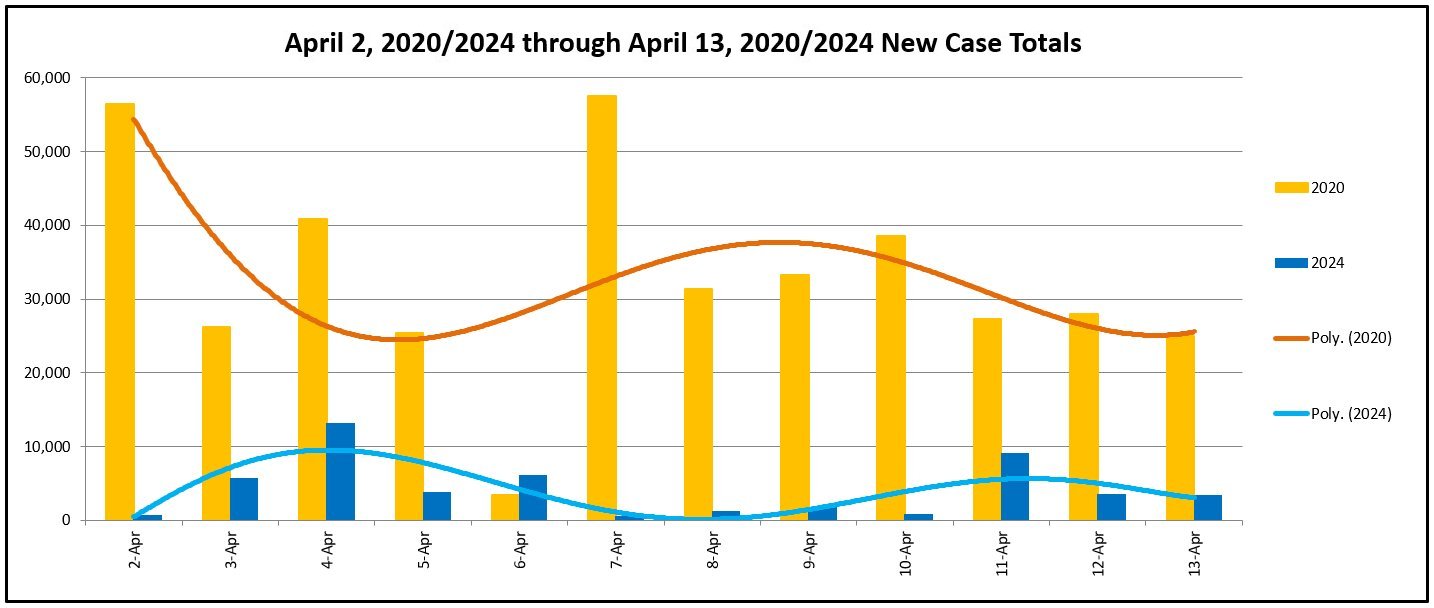
April 6th was the only day that showed fewer new cases in 2020 than in 2024. I suspect that this is a result of the way states were reporting in 2020 and 2024. For the past year or so, many states have reported COVID-19 cases and deaths only once a week … on Friday. Those reports didn’t appear until the next day. April 6, 2024 was a Saturday. In 2020, all states reported their data on Monday through Saturday. The states that had the most cases early in the pandemic reported every day. A spike in data on Monday or Tuesday was common. April 6, 2020 was a Monday.
Whether April 6th in 2020 and 2024 represent a statistical anomaly or a real difference in the number of new cases, the other 11 days show a dramatic difference … by tens of thousands … between 2020 and 2024.
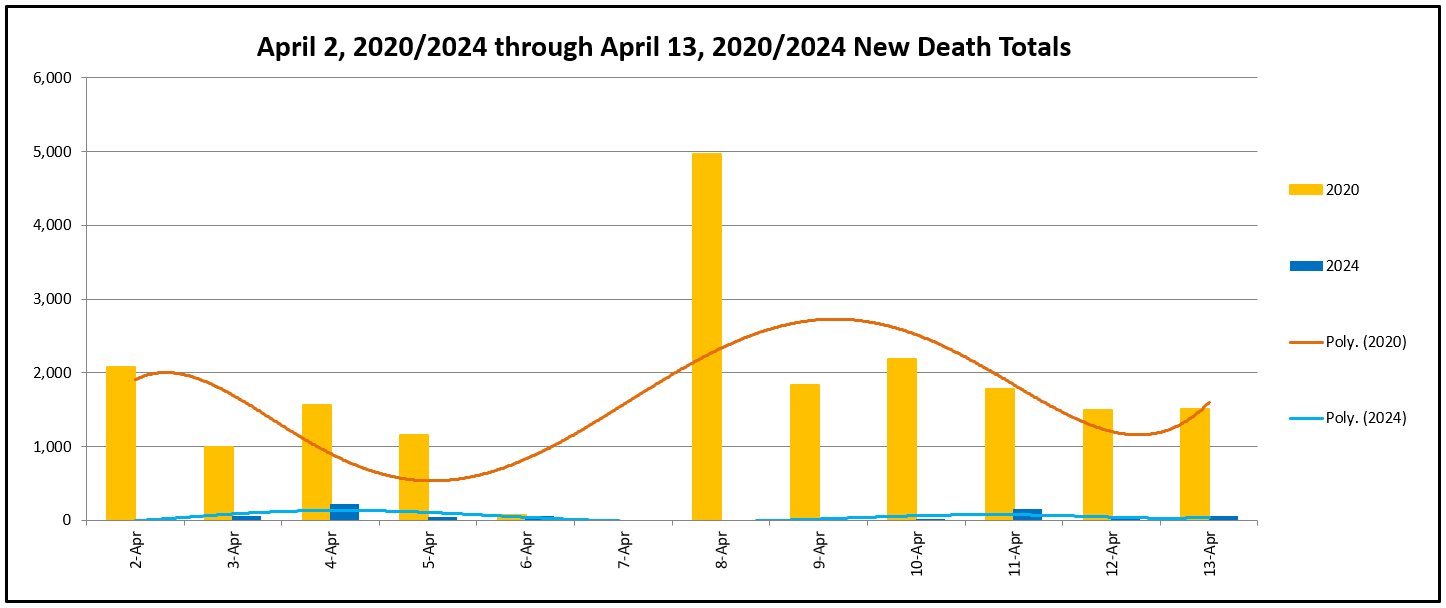
The new deaths chart shows an even more dramatic difference between 2020 and 2024. Once again, April 6th has a very low value in both years … and is joined by April 7th. What is most obvious is that the 2024 numbers are extremely low. Between the vaccines and annual boosters, Paxlovid and other treatments, and a more informed public, we have come a long way between 2020 and 2024.
I don’t know about you, but I’m better off now than I was four years ago.
- I can leave my home without wearing a face mask and rubber gloves.[6]
- When I go to the grocery store,[7] I don’t have to worry about some fool whose mask is covering his mouth, but not his nose … nor one who is not wearing any mask at all.
- I don’t have to maintain a 6-foot distance from other people nor follow one-way arrows on the floor when I’m in a stores with asiles.
- Non-essential stores, restaurants, public buildings, etc. are open again.
- I don’t have to listen to ignorant governors berating school children for wearing their masks.[8]
- Toilet paper is readily available. It may cost a bit more[9], but it’s easy to find locally.
By January 19, 2021, the last full day of Donald Trump’s Presidency, 27,861,579 people in the 50 states and the district of Columbia had contracted COVID-19. 399,866 of those people had died of the disease. In February of 2021, The Lancet Commission on Public Policy and Health in the Trump Era estimated that 40% of U.S. COVID-19 deaths could have been avoided if the Trump Administration had reacted with preventative action rather than denialism. Forty percent of 399,866 is 159,946 U.S. citizens who would not have died from COVID-19. The population of the United States at the end of Trump’s last year[10] was 335,942,003. About 0.05% of the population of the United States died because of COVID-19 in 2020.
Am I better off now than I was in 2020? You’re damned right I am … and so are most of the rest of the people in the United States. Senator Britt needs better speech writers. The old cliches no longer work. Most Republican members of the House and Senate need to remove their Orange-colored glasses so that they can see the country and the world the way the rest of us see it.
Me … I’m going to follow the advice of Emmett “Doc” Brown of “Back to the Future” fame.

I encourage you to do the same … whether you’re time-travelling figuratively or literally.
If you want to share this article … through social media, re-post, e-mail, or any other medium …, please feel free to do so.
If you have any comments or additional ideas, I encourage to leave a reply in the comments section at the end of this article. (The link below will skip over the Notes section.)
[ Go to Main Menu ]
Notes
[1]
If you’d like to review the State of the Union Address, the Republican Response, or both her they are:
The State of the Union Address
The Republican Response
[2]
By interesting coincidence, January 20, 2020 was also the first day of the last year of Donald Trump’s Presidency.
[3]
In case you’ve forgotten or were living way off the grid, here’s a 31 minute and 24 minute synopsis of the first year of the COVID-19 Pandemic in the United States and the Trump Administration’s response to it.
[4]
What can I say, I’m more than a little captivated by and obsessed with statistics. It’s an incurable, but seldom terminal, disease I caught in graduate school. 😉
[5]
Worldometer collects data from the whole world. (If it didn’t it wouldn’t be called Worldometer.) Since sometime last year, most of the world’s countries are reporting COVID cases and deaths sporadically if it all.
[6]
I quickly learned that the rubber gloves might not provide a lot of protection . (I watch a lot of TV news.) I continued to wear the gloves whenever I had to leave home because they protected my hands from the side-effects of using lots of hand sanitizer. The gloves temporarily kept the virus off my hands; the sanitizer cleaned the gloves without touching my skin.
[7]
In the early months of 2020, when the virus was totally out of control in my section of the country, the only times I left home was to go to the grocery or the drugstore.
[8]
[9]
The toilet paper shortage was the result of an oversight in the “just in time” production of paper products. Almost every company that sold paper products had separate supply lines for commercial and retail production. After the pandemic forced the shutdown of public places … office buildings, hotels and restaurants, schools, etc. … the commercial supply line had production capabilities that far outstripped the demand. At the same time, with everyone stying at home, the retail supply line could not meet the increased demand.
Inflation is the result of demand exceeding supply. Along with the rest of the world, U.S. demand for almost everything dropped catastrophically. Here’s a chart that shows the trend.
The purple bars represent each year’s COVID-19 Cases. The orange bars represent each year’s Inflation Rate on December 31st.

- In 2020, the inflation rate dropped as COVID-19 cases increased.
- The vaccines began to push back the Alpha Strain of the disease in 2021. We started to emerge from our homes, seeking the goods and services that we had been missing. Demand increased and inflation increased with it. Unfortunately, 2021 ended with COVID’s more virulant Omega Strain supercedeing the Alpha Strain. Our “coming out party” collided with a surge in the disease creating new problems:
- As the COVID-19 Cases began to rise again, many people questioned the efficacy of the vaccines.
- Many others believed that the vaccines were a COVID-19 panacea and threw all caution to the wind. Without a thought, they packed themselves into venues and events that guarenteed the spread of airborne viruses … from the common cold to Omega Strain COVID-19. (No vaccine is forever. Until smallpox was eradicated, a vaccination against it was only good for 5-10 years. After a child recovers from chicken pox, the virus can “go to sleep” for decades, then “wakes up” to cause shingles.)
- The Federal and State governments had to devote resources toward the development and distribution of booster COVID-19 vaccines that covered the Omega Strain. (Since then, COVID-19 vaccination has joined Influenza in requiring an annual innoculation.)
- As the COVID-19 Cases began to rise again, many people questioned the efficacy of the vaccines.
- In 2022, COVID-19 cases began a steady decline and the inflation induced by the pandemic-induced supply-and-demand mismatch peaked. (The effects in Economics, like those in many of the social sciences, tend to lag behind the causes. It’s not like cause-and-effect in the physical sciences where you strike a match and get fire or let go of a rock and it falls to the ground.)
- In 2023, the COVID-19 pandemic moved to endemic (like the flu) and inflation began a decline that continues today.
[10]
335,942,003 does not included January 1st through 19th of 2021. End of Year population figures were the best I could find.

 My Less Than Humble Opinion