
Election 2026 #4
Do You Vote By Mail?
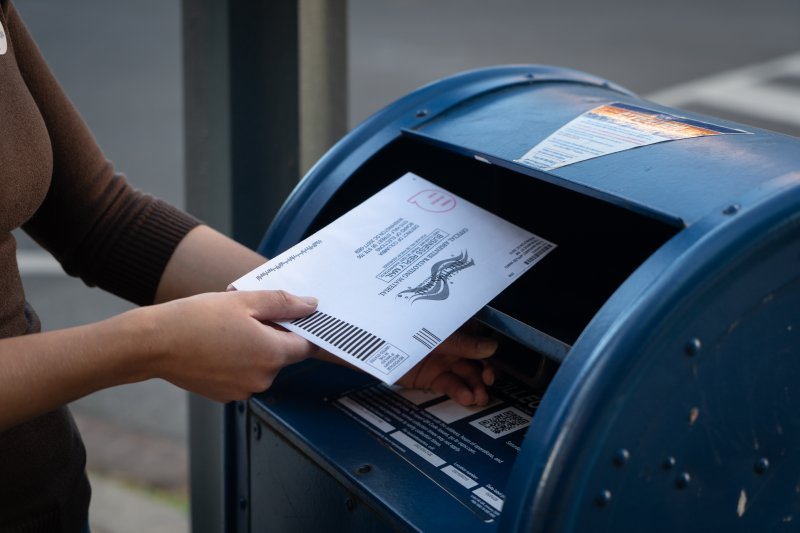
If your answer to the question posed by the above header is, “Yes”, you have a lot of company. Mail-in voting has tripled over over the past 20 years. It seems likely that some of the increase is the result of continuing, small increases in longevity in the United States.[1]
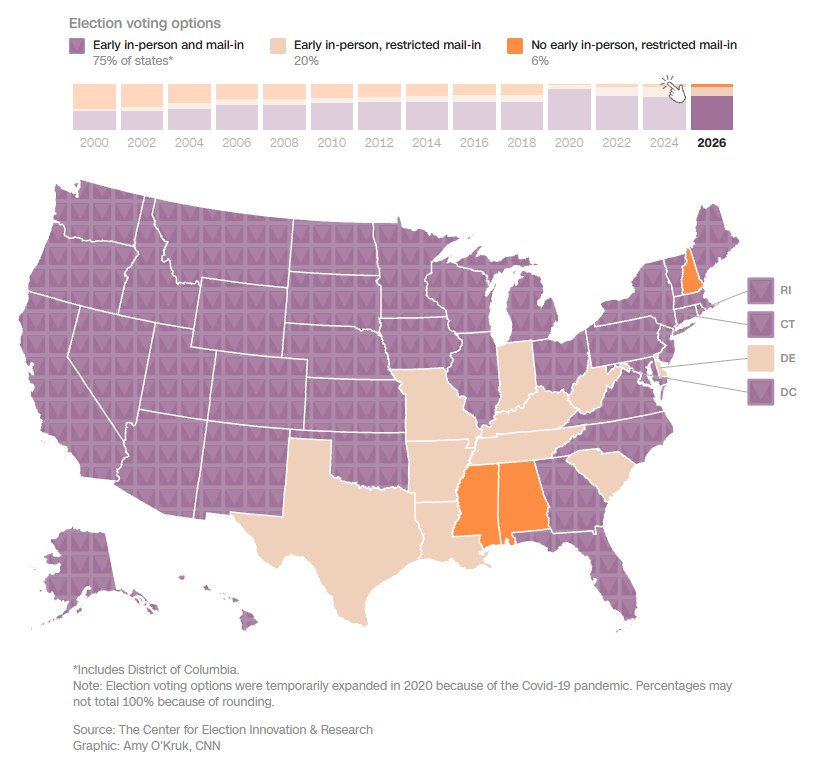
The COVID-19 pandemic created a dramatic increase in the use and popularity of mail-in voting. The COVID vaccines did not receive emergency authorization until December 2020. To protect public health, many states began to provide unrestricted voting by mail{2] for the 2020 election.
In 2024, 37 states have unrestricted mail-in voting. The remaining 13 have restricted mail-in voting. Only 3 had restricted mail-in voting and no early in-person voting. In those states, if you don’t have a state-approved reason for needing to vote by mail (e.g., military, physical disability, etc.), you are required to vote at the polls on election day,
Who Decides the When, Where, and How?
As I pointed out in Election 2026 #3, Article I, Section 4, Clause 1 of the Constitution of the United States says:
The Times, Places and Manner of holding Elections for Senators and Representatives, shall be prescribed in each State by the Legislature thereof; but the Congress may at any time by Law make or alter such Regulations, except as to the Places of chusing Senators.[3]
It does not say:
The Times, Places and Manner of holding Elections for Senators and Representatives, shall be prescribed in each State by the Legislature thereof; but the Congress by Law or the President by Executive Order may at any time make or alter such Regulations, except as to the Places of chusing Senators.
Nevertheless, President Trump issued Executive Order 14399 entitled “Ensuring Citizenship Verification and Integrity in Federal Elections” on March 31, 2026. The order required states to work with the U.S. Postal Service and other government agencies to create lists of eligible citizen voters and deliver mail ballots only to voters on those lists.
The League of Women Voters of Massachusetts initiated a lawsuit to stop the executive order. The courts agreed. It’s too late for the government to appeal the decisions. Mail-in and early voting have started in a number of states. For the full story, check this article on the LWV’s website.
President Trump’s reaction has been predictable to anyone who’s been paying attention. He’s now telling his supporters to vote for Republican candidates in any way they can … at the polls on November 3rd, at early voting sites in states that provide that option and, of course, by mail.
When is a Midterm not a Midterm?
Election Day is fewer than 3 weeks away. Early voting and Mail-in voting are already under way in many states. Rather than doing his job, President Trump is holding “campaign rallies” in several states that he won in 2024. His intent is to encourage his supporters to vote for the Republican candidates. He’s telling those attending his rallies, “Pretend I’m on the ballot.”[4]
The incumbent Republicans who can read the handwriting on the wall know that most of the U.S. population are unhappy with ever increasing prices, yet another war in the Middle East, and our country becoming a world pariah. They know that a large percentage of the population blame President Trump’s tarriffs, ill-conceived and mismanaged attack on Iran, and distain for our traditional allies for those problems.
The more intelligent incumbent Republicans are distancing themselves from the President. Their opponents are saying, “Sure, come to our state. Glad to have you (i.e., your unintended help).”
What’s Next?
From President Trump and his Supporters …
The Department of Justice is deploying approximatly 1,000 election monitors to polls across the country. The NAACP is is concerned that these monitors may be searching for “evidence” of wide-spread voting fraud and/or using I.C.E and other federal officers to intimidate voters. They have submitted a Freedom of Information Act request for information, The DOJ has not complied. The NAACP has sued.
The President, his Cabinet, some members of the House and Senate, Republican Party loyalists, and the MAGA faithful have suggested other ways of tampering with the Midterms. If we want fair and honest midterm elections that reflect the opinions and concerns of the majority of our citizens, we must be prepared for:
- Thugs, either official or “volunteer”, attempting to intimidate voters;
- Fearful and/or apathetic anti-Trump voters avoiding voting altogether;
- Verbal and/or physical attacks on state election officials;
- Claims of fraud and election denial;
- President Trump declaring a state of emergency and/or applying The Insurrection Act as an excuse for cancelling the Midterms and/or declaring marshall law.
From Those Who Oppose Him and his Mob …
If you believe that:
- Tariffs are paid by exporters rather than importers[5] and are bringing a fortune to the U.S. Treasury from other countries;
- The high cost of living and continuing inflation is inherited from the previous administration and is being brought under control by the Trump Administration;
- The high cost of oil is the result of the green energy policies of the previous administration;
- The War with Iran is absolutely necessary to prevent them from getting nuclear weapons;[6]
- The war in Ukraine continues because of the policies and aggression of Volodymyr Zelenskyy’s government;
- The 985,000 persons that the Department of Homeland Security (DHS) claims to have deported were all undocumented non-citizens and “the worst of the worst”;
Feel free to stay home on election day. Sit back, relax, and enjoy your “Kool-Aid“.
If , on the other hand, you believe that the policies of President Trump and his administration are responsible for:
- Our runaway inflation … especially in the area of anything that requires petroleum products;
- I.C.E. morphing into a group of thugs who can brutalize and murder undocumented immigrants, documented immigrants, and U.S. citizens without regard for due process and with no fear of disciplinary action;
- The President, his Family, his Cabinet, and their friends getting rich at the expense of the taxpayers;
- The United States becoming a pariah state and/or a joke in the eyes of the rest of the world,
It is time for an unprecedented turnout in the Midterm Elections!
On or by November 3rd:
- Be sure you’re registered to vote at: https://www.nass.org/can-I-vote;
- Make a plan for voting by:
- Learning what you can about the candidates and issues.
- Voting early, if you have that option; or
- Voting by mail, if you have that option; or
- Voting at your polling place on election day, (If you’re concerned about intimidation at the polls, go with a friend and/or neighbor and stick together … except in the voting booth. of course.)
- Learning what you can about the candidates and issues.
Remember that, according to the Constitution,
We the People are in charge of the country.
Those we elect work for us.
I encourage you to share this article … through social media, re-post on your own website (blog), e-mail, word-of-mouth, pony express, carrier pigeon, or any other medium.
If you have any comments … in agreement or opposition … or any additional ideas, please leave a reply in the comments section at the end of this article.
If you choose to subscribe to this website, the only “junk mail” you’ll receive is a note whenever I post a new article. I do not have any advertisers. I want to be free to express “my less than humble opinion” whenever and however I choose.
[ Go to Comments Section ]
[ Go to Main Menu ]
Notes
[1]
Even President Trump votes by mail. As we shall see, taking advantage of mail-in voting is a bit hypocritical on his part.
[2]
The primary difference between restricted and unrestricted mail-in voting centers on who is permitted to use a mail ballot.
- Unrestricted mail-in voting allows any eligible, registered voter to request and cast a ballot by mail without providing a reason. In some jurisdictions, election officials automatically mail ballots to all registered voters by default.
- Restricted mail-in voting limits mail-in ballots to voters who meet strict eligibility criteria. Voters typically must provide a state-approved reason—such as an illness, physical disability, military deployment, or documented travel out of the area on Election Day—to legally qualify for a mail ballot.
(For what it’s worth, the above definition is a direct copy of Google AI’s response to my question, “What is the difference between restricted and unrestricted mail-in voting?” Artificial Intelligence isn’t all bad. Like atomic energy, it requires regulation defining limits and use. As for the data centers needed for AI (and other processer-hungry applications. If we can launch a telescope into the Sun-Earth Lagrange point, we can launch a series of inter-connected data centers into high, uncrowded orbits, They can be powered by solar energy not restricted by an atmosphere ,,, and, if they get too warm, we can just open a window. 😉)
[3]
The Framers of the Constitution left it to the State Legislatures to select their two Senators. The 17th Amendment changed the method of selecting Senators to a popular vote by the state’s citizens.
(Note: the word “chusing” is not a typo. That’s the 18th Century spelling of the word “choosing”.)
[4]
Typically, more U.S. citizens vote in Presidential election years than in Midterm election years. Believing that he is very popular, President Trump’s suggestion to pretend he’s on the ballot is essentially, “Pretend this is a Presidential election year,” Obviously, he doesn’t understand that dissatisfaction with the current state of affairs is usually the driver of large turnouts in Midterm elections.
[5]
Or if, like the President, you don’t know the difference and don’t want to know.
[6]
The Joint Comprehensive Plan of Action (JCPOA) is/was a multinational deal designed to prevent Iran from developing nuclear weapons. It required regular reports on Iran’s nuclear program for domestic use (e.g., power production) and inspections of production sites by international experts. President Trump pulled the United States out of that agreement during his first administration because “it didn’t go far enough”. (I suspect that the real reason that Trump didn’t like the JCPOA was because it was crafted and signed during the Obama Administration.)

